


The Success of B40 and Indonesia’s Roadmap to Zero Diesel Imports by 2026


The year 2025 stands as a crucial milestone for Indonesia’s energy sector. Amidst global efforts to balance energy needs with environmental sustainability, Indonesia has proven its mettle as a leader in biofuel innovation. During a performance press conference in early January 2026, Minister of Energy and Mineral Resources (ESDM), Bahlil Lahadalia, delivered news that brings high optimism: Indonesia is now on the threshold of full diesel self-sufficiency.
The Success of the B40 Mandate: Reducing Foreign Dependency
The implementation of the B40 mandatory program—a blend of 40% Palm Methyl Ester (FAME) and 60% fossil diesel—has proven to be a highly effective instrument in strengthening national energy security. This success is evident from the sharp decline in diesel import volumes over the past two years.
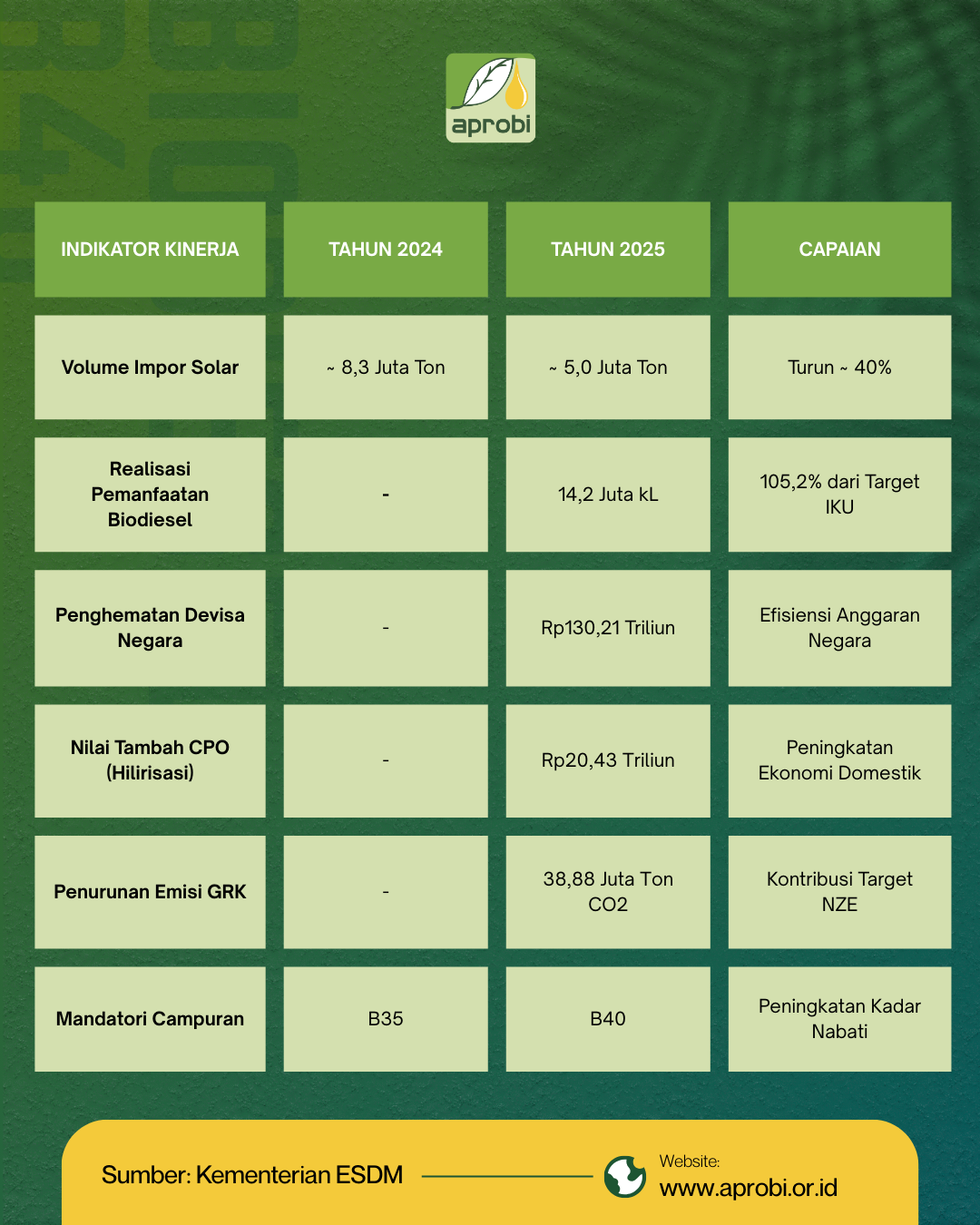
Minister Bahlil revealed that in 2024, Indonesia still had to import approximately 8.3 million tons of diesel to meet domestic demand. However, as the biodiesel program was strengthened throughout 2025, that import figure was successfully suppressed to approximately 5 million tons. A nearly 40% reduction within a single year is no small feat; it is the result of an end-to-end commitment to optimizing national palm oil potential.
According to official ESDM data, the realization of domestic biodiesel utilization throughout 2025 reached 14.2 million kiloliters (kL). This figure exceeded the Key Performance Indicator (IKU) target of 13.5 million kL, reaching 105.2% of the initial goal. This achievement indicates that Indonesia’s distribution infrastructure and industrial engine readiness have successfully adapted to higher bio-blends.
The Domino Effect: Forex Savings and Environmental Benefits
The benefits of the B40 program extend beyond the energy sector, impacting fiscal health and the environment. From a macroeconomic perspective, this policy has served as a savior for the national trade balance. In 2025 alone, foreign exchange savings reached a staggering Rp 130.21 trillion. Funds that were originally destined to flow abroad to purchase fossil diesel now remain within the country to stimulate the domestic economy.
In addition to forex savings, the program provides significant added value to the agribusiness sector. The downstreaming of Crude Palm Oil (CPO) into biodiesel contributed an economic value-add of Rp 20.43 trillion. On the environmental front, Indonesia’s commitment to Net Zero Emission (NZE) is increasingly tangible, with 2025 biodiesel utilization successfully reducing greenhouse gas emissions by 38.88 million tons of $CO_{2}$ equivalent.
Looking Toward 2026: Two Pillars for Zero Diesel Imports
Encouraged by this positive trend, the Indonesian government has confidently set a target for Zero Diesel Imports by 2026. To realize this ambition, the government has prepared two primary strategies to run in tandem:
-
Transitioning to B50: Technical trials for B50 biodiesel are scheduled for completion in the first half of 2026. If technical evaluations, engine performance, and economic feasibility yield positive results, the B50 mandate will be officially launched in the second half of 2026.
-
Operationalization of RDMP Balikpapan: The second pillar is the strengthening of domestic refinery capacity. The Refinery Development Master Plan (RDMP) project in Balikpapan, East Kalimantan, is projected to be inaugurated soon. This project will massively increase domestic diesel production capacity, closing the gap previously filled by imports.
“If we can implement B50 and the RDMP project in East Kalimantan officially operates, then in 2026, we will no longer import diesel,” Minister Bahlil stated optimistically.
The Challenge of High-Quality Diesel (CN51)
While optimism regarding total diesel volume is high, the government maintains transparency regarding CN51 (Cetane Number 51) Diesel. This high-quality diesel, widely used in heavy machinery industries, still faces domestic production capacity challenges. Therefore, limited and selective import options for CN51 remain open while domestic refineries are developed to meet those quality standards.
Indonesia has proven that with bold innovation and strong political will, energy transition is not just about preserving the planet—it is about safeguarding economic sovereignty. The success of B40 in 2025 is the solid foundation for Indonesia to truly break free from the shackles of fossil diesel imports in 2026.