


Garut’s Sugar Palm Nectar Transformed into Bioethanol: Realizing National Self-Sufficiency


Amidst Indonesia’s efforts to accelerate its energy and food self-sufficiency agenda, a green energy innovation has emerged from the verdant slopes of Kamojang, Garut. PT Pertamina NRE (New & Renewable Energy) officially launched a pilot project for developing sugar palm-based bioethanol in the region last Wednesday (11/19).
This initiative transforms the traditional function of sugar palm nectar (nira)—previously processed into sugar by the Social Forestry Business Group (KUPS) Baru Bojong—into a fuel of the future. From this modest installation, 300 liters of bioethanol can be produced daily, while simultaneously yielding 300–500 kilograms of palm sugar, demonstrating a harmonious economic integration.
Sugar Palm as a Pillar of Energy Security
The project launch is fully supported by the government, as outlined in the Minister of Forestry Decree Number 440 of 2025 regarding the formation of an acceleration team for sugar palm development. Forestry Minister Raja Juli Antoni emphasized that this project aligns with President Prabowo’s Asta Cita vision to realize energy security.
“In an uncertain geopolitical situation, it is vital that we explore potential domestic energy sources, one of which is the sugar palm,” said Raja Juli. He highlighted the plant’s massive potential: theoretically, 1 hectare of sugar palm can produce 24,000 liters of bioethanol per year. With total potential land reaching 125 million hectares, the government plans to plant 1.2 million hectares of sugar palm, which could potentially yield 28.8 million kiloliters of bioethanol annually. This figure is expected to significantly reduce fuel import costs.
Dual Benefits for the People and the Environment
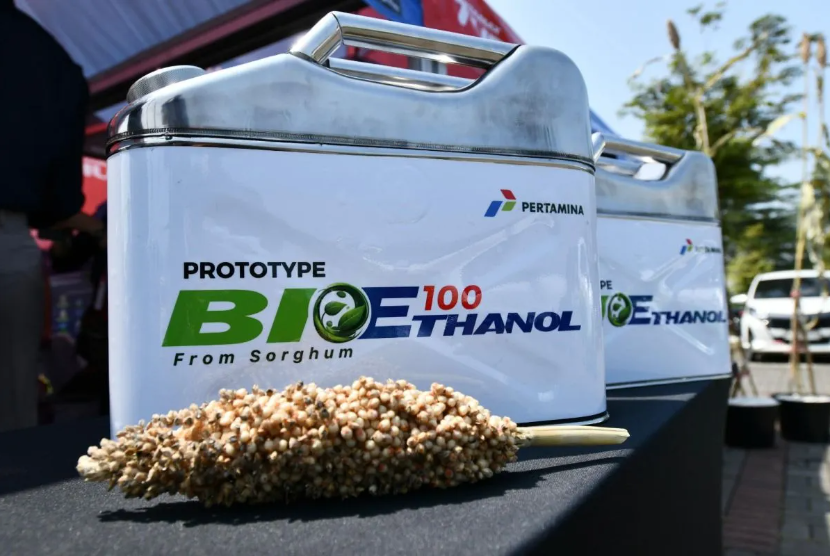
John Anis, CEO of Pertamina NRE, explained that the sugar palm is a high-potential crop that can be developed on a massive scale. This project is part of Pertamina’s multi-feedstock bioethanol strategy. In addition to sugar palm, Pertamina is researching other raw materials, such as sugarcane molasses, sorghum, cassava, corn, and agricultural waste (POME, bagasse, and straw).
The development of sugar palm-based bioethanol brings several strategic benefits:
-
Local Economic Support: Creating new job opportunities and boosting the economy for palm farmers, as experienced by KUPS Baru Bojong.
-
Marginal Land Utilization: Sugar palms can thrive on less productive land.
-
Energy Transition: Reducing dependence on fossil fuels and fuel imports.
-
Climate Contribution: Contributing to emission reductions through the utilization of biofuels.
This pilot project, which also involves collaboration with the National Research and Innovation Agency (BRIN), will undergo testing phases ranging from laboratory scale to commercial and industrial replication. This represents a long-term strategy to ensure the availability of sustainable raw materials and strengthen national energy self-sufficiency.