


Indonesia’s Energy Self-Sufficiency 2025: Realizing the Asta Cita Vision


The year 2025 will be remembered as a pivotal period in Indonesia’s energy history. Under the Asta Cita vision launched by President Prabowo Subianto, Indonesia is no longer merely dreaming of energy independence; it is taking concrete steps toward total self-sufficiency. The Ministry of Energy and Mineral Resources (ESDM) has been at the forefront, translating this vision of sovereignty through various policy breakthroughs, with the B40 Biodiesel mandatory program as its spearhead.
Navigating Global Dynamics
In a performance report for the energy sector delivered in early January 2026, the Minister of Energy and Mineral Resources, Bahlil Lahadalia, acknowledged that 2025 was not an easy year. He described the period as one filled with “ups and downs” and extraordinary challenges. Volatile global energy markets and international pressure regarding the energy transition demanded exceptional policy agility.
“2025 was a year full of trials and dynamics. However, for us, every challenge is an opportunity to manifest our presence and achieve the targets set by the President,” Bahlil emphasized. This spirit became the driving force for the ministry to not only survive but to exceed established strategic targets.
The Success of B40: Exceeding Targets and Slashing Imports
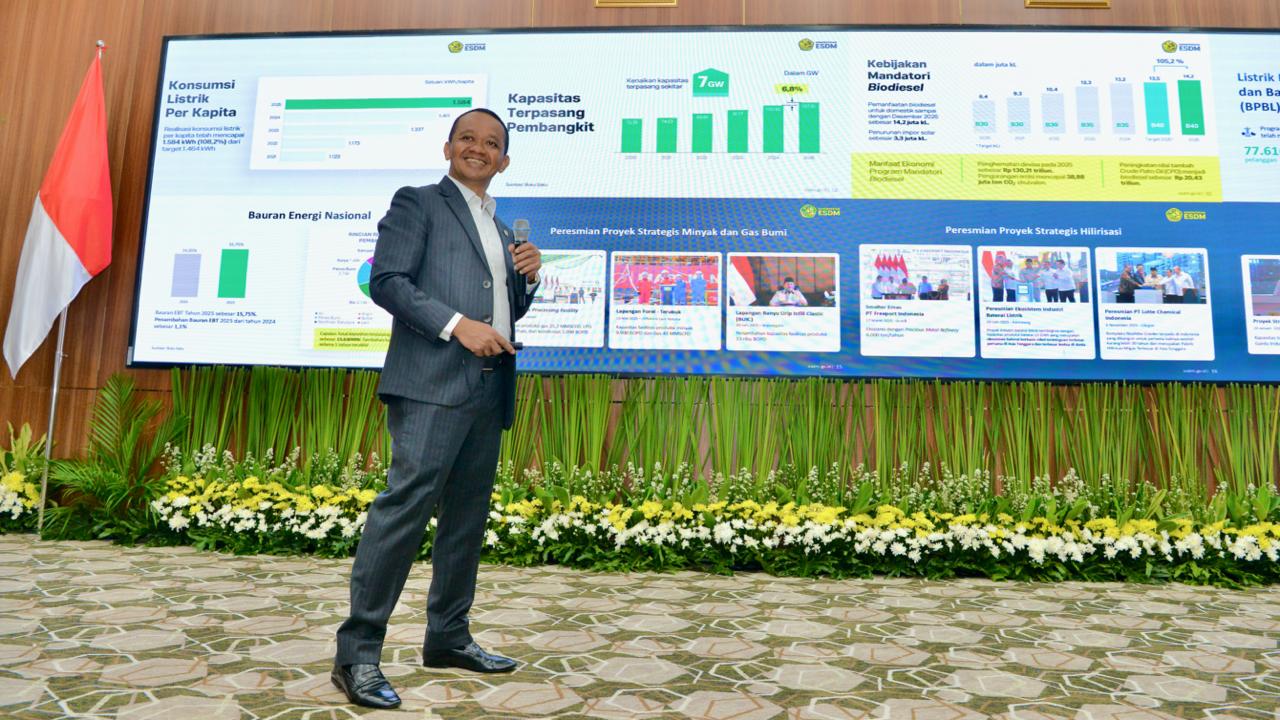
Tangible proof of the state’s presence in safeguarding energy security is the successful implementation of the B40 policy (a blend of 40% palm oil and 60% diesel). Based on data from January to December 2025, domestic biodiesel utilization recorded an impressive figure of 14.2 million kiloliters (kL).
This figure represents 105.2% of the Key Performance Indicator (IKU) target, which was originally set at 13.5 million kL. This success had an immediate impact on the national energy import structure. The B40 mandate effectively slashed diesel import volumes by 3.3 million kL. This reduction is not just a statistical milestone; it is a symbol of Indonesia’s decreasing reliance on foreign fossil fuels.
Economic Impact and Domestic Added Value
The biodiesel program is about more than just engines and fuel—it is about strengthening fiscal sovereignty. The success of B40 in 2025 provided significant economic benefits to the state treasury. In terms of foreign exchange savings, this policy successfully saved the national budget Rp 130.21 trillion. Foreign exchange that would typically flow abroad to purchase diesel now remains within the country, strengthening the Rupiah and providing fiscal space for other development sectors.
Furthermore, the downstreaming of the palm oil industry received a fresh injection of energy. The program increased the added value of Crude Palm Oil (CPO) into biodiesel by Rp 20.43 trillion. This ensures that the economic benefits of palm oil plantations are not enjoyed only by a few exporters but touch the entire national energy supply chain and improve the welfare of upstream farmers.
Asta Cita: Environmental Commitment and a Green Future
In line with Indonesia’s global commitment to reducing carbon emissions, B40 has become the most effective decarbonization instrument in the transportation sector. Throughout 2025, the implementation of this biodiesel successfully reduced greenhouse gas emissions by 38.88 million tons of CO2 equivalent.
This achievement places Indonesia in a strong position on the roadmap toward Net Zero Emission (NZE) 2060. With the success of B40, the path toward “green” and sustainable energy self-sufficiency is wider than ever. The government is optimistic that the foundation laid in 2025 will serve as a stepping stone to increase the blend to B50 in the future. This establishes Indonesia as a self-sufficient and sovereign global bioenergy giant.
The journey of 2025 proves that challenges are opportunities for innovation. Through the Asta Cita vision and hard work in the ESDM sector, Indonesia has not only secured the people’s energy supply but also safeguarded foreign exchange, lowered emissions, and solidified its position as a global leader in plant-based energy.